
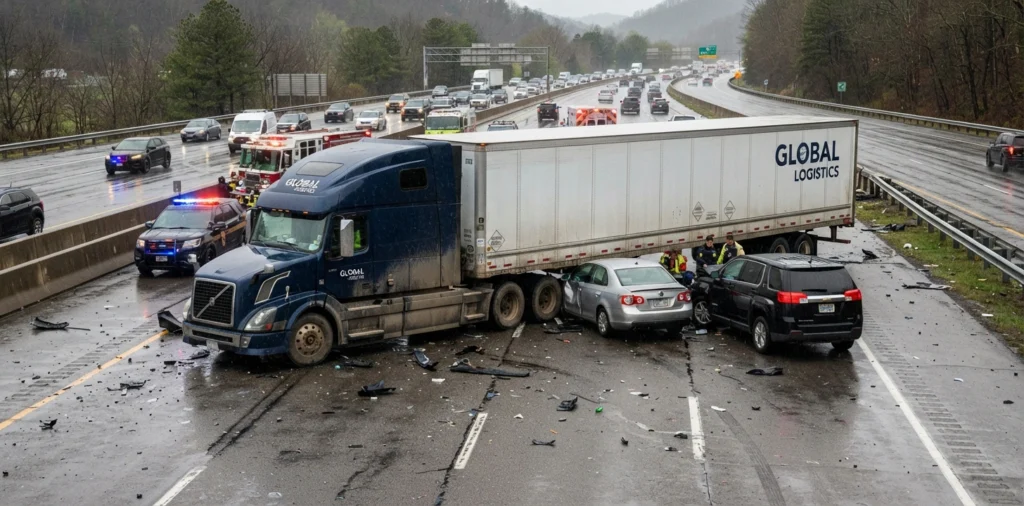
A semi truck jackknife accident happens when the tractor and trailer move out of alignment and form an angle resembling a folding pocketknife. These crashes can occur when braking, steering, speed, road conditions, cargo, or mechanical problems disrupt the truck’s stability. In Houston, heavy traffic, rain, merging lanes, construction zones, and frequent commercial-vehicle activity can create conditions in which a loss of control becomes especially dangerous.
Common causes include excessive or unsafe speed, hard braking, slippery pavement, improper following distance, driver fatigue, unsafe lane changes, tire or brake defects, and improperly secured or distributed cargo. The specific cause matters because it can affect who may be legally responsible for a victim’s injuries and losses. If you need help after a collision, a truck accident lawyer Houston Texas can help explain your options.
What Is a Jackknife Truck Accident?
A jackknife truck accident occurs when the trailer swings sharply relative to the tractor, causing the combination vehicle to form a pronounced angle. The trailer can move sideways across lanes while the tractor continues in another direction.
This movement can block multiple lanes and strike nearby vehicles. A passenger vehicle may have little time or space to avoid the trailer. Because of the size and weight of commercial trucks, a jackknife collision can result in substantial vehicle damage and serious injuries.
Federal Motor Carrier Safety Administration data has historically tracked jackknife involvement in large-truck crashes. For example, FMCSA reported that 169 large trucks in fatal crashes were recorded as jackknifing in 2020. The agency defines a large truck for that dataset as a vehicle with a gross vehicle weight rating above 10,000 pounds.
What Causes a Semi Truck to Jackknife?
Several factors can contribute to a jackknife. Investigators generally need to examine the circumstances of the individual crash rather than assume one cause. If you were injured in a jackknife collision, a truck accident lawyer near me can help investigate the potential causes and identify parties who may be responsible.
1. Excessive or Unsafe Speed
Speed can make it harder for a truck driver to maintain control, particularly when traffic, curves, rain, or other hazards require slower travel. Texas Transportation Code §545.351 requires drivers to operate at a speed that is reasonable and prudent under existing circumstances and requires an appropriate reduction when special hazards involve traffic, weather, or highway conditions.
A driver traveling too quickly for wet pavement, congested Houston traffic, or a sudden obstruction may have less time to respond safely.
2. Hard or Improper Braking
Sudden braking can contribute to loss of control when the tractor and trailer do not remain properly aligned. Emergency braking may be unavoidable in some circumstances, so the presence of hard braking alone does not establish negligence.
Investigators may instead examine why the driver braked, vehicle speed, traffic conditions, brake performance, tire condition, and whether the driver had a reasonable opportunity to avoid the collision.
3. Wet or Slippery Roads
Rain can reduce tire traction and make stopping more difficult. Federal Motor Carrier Safety Regulation 49 CFR §392.14 requires extreme caution when hazardous conditions such as rain, fog, snow, ice, or other conditions adversely affect visibility or traction. It also requires speed reduction when those conditions exist.
Houston’s weather can therefore become an important part of a truck crash investigation when rainfall or standing water is involved.
4. Improper Following Distance
Following too closely can leave a truck driver without enough stopping distance when traffic suddenly slows. Texas Transportation Code §545.062 requires an operator to maintain an assured clear distance that allows the vehicle to stop safely under the speed, traffic, and highway conditions.
A commercial truck’s stopping characteristics can make adequate following distance especially important.
5. Driver Fatigue
Fatigue can affect reaction time, attention, judgment, and decision-making. Federal hours-of-service rules regulate driving and on-duty periods for many property-carrying commercial drivers. FMCSA explains that these requirements are contained primarily in Part 395 of the Federal Motor Carrier Safety Regulations, subject to applicable exceptions.
If fatigue is suspected, investigators may examine driver logs, electronic logging data, dispatch records, schedules, and other evidence.
6. Unsafe Lane Changes or Steering
A tractor-trailer can become unstable when a driver makes an unsafe steering maneuver, changes lanes abruptly, or reacts suddenly to surrounding traffic. Texas law generally requires drivers on multilane roadways to remain within a lane as nearly as practical and prohibits changing lanes unless the movement can be made safely.
This can be particularly important on Houston-area freeways where multiple lanes, ramps, merging traffic, and commercial vehicles interact.
7. Tire, Brake, or Other Mechanical Problems
Mechanical failures can contribute to a jackknife when a critical component does not perform as expected. Federal regulations address commercial motor vehicle inspection, repair, and maintenance. FMCSA states that carriers must address defects or deficiencies that could affect safe operation, and commercial vehicles are subject to periodic inspection requirements.
A crash investigation may therefore examine maintenance records, inspection reports, repair invoices, tire condition, brake components, and other vehicle evidence.
8. Improperly Loaded or Secured Cargo
Cargo that is improperly distributed, insufficiently secured, or otherwise affects the vehicle’s stability can contribute to loss of control. The exact significance depends on the truck, trailer, cargo, and loading method involved.
Evidence may include bills of lading, loading records, photographs, inspection documentation, and information identifying the company or contractor responsible for loading the vehicle.
Who May Be Responsible for a Jackknife Truck Accident?
Responsibility depends on what caused the crash and which parties contributed to it. Potentially responsible parties can include the truck driver or trucking company, but a claim may also involve a maintenance provider, cargo-loading company, manufacturer, or another party.
Texas uses proportionate responsibility in many tort cases. Under Texas Civil Practice and Remedies Code §33.001, a claimant generally cannot recover damages if the claimant’s percentage of responsibility is greater than 50 percent. If a claimant is 50 percent or less responsible, the allocation of responsibility can affect the damages that may be recovered. The evidence should determine the allocation rather than assumptions about who was driving the truck.
Read Related: Truck Accident Liability in Texas
What Evidence Can Help Prove the Cause?
Evidence can help establish how the jackknife occurred and whether another party’s conduct or equipment contributed to it.
Useful evidence may include:
- Police or crash reports
- Photographs and videos from the scene
- Dashcam or surveillance footage
- Witness statements and contact information
- Truck and trailer inspection records
- Driver logs and electronic logging information
- Maintenance and repair records
- Tire and brake evidence
- Cargo and loading documentation
- Medical records and bills
- Employment and income records showing lost wages
For Houston crashes investigated by the Houston Police Department, crash reports can be requested through HPD’s records process. HPD states that Texas Peace Officers’ Crash Reports are filed with TxDOT and provides instructions for obtaining accident or crash reports. TxDOT is the custodian of Texas crash records and explains that a person directly concerned in an accident may qualify to obtain a crash report under Texas Transportation Code §550.065.
When Should You Speak With a Truck Accident Lawyer?
You may want to speak with a qualified Texas attorney when a jackknife crash caused significant injuries, extensive property damage, disputed liability, permanent impairment, lost income, or a fatality. Legal guidance may also be useful when an insurance company disputes responsibility or when multiple parties may have contributed to the crash.
Texas generally imposes a two-year limitations period for personal injury lawsuits under Civil Practice and Remedies Code §16.003, although exceptions can apply and different rules may govern particular claims. Do not assume you have two years to investigate every potential claim. Federal trucking regulations can also become relevant, particularly when an interstate commercial motor carrier is involved. Texas law and federal regulations do not automatically determine civil liability; the facts, evidence, applicable duties, and legal claims must be evaluated together.
Read Related: When to Consult a Lawyer for a Truck Accident
How Can Houston Truck Crash Victims Investigate a Jackknife?
A Houston truck crash investigation may require looking beyond the vehicles themselves. Investigators can consider roadway conditions, traffic patterns, weather, vehicle damage, braking evidence, driver conduct, maintenance history, cargo, and available electronic records.
Houston’s major highways can carry substantial commercial traffic, and crashes may occur during complicated traffic conditions involving entrance ramps, construction areas, congestion, or sudden lane changes. These circumstances do not establish negligence by themselves, but they can provide important context for determining what happened. The goal is to identify the actual chain of events rather than assume that a jackknife automatically means the truck driver was at fault.
Get Help After a Houston Jackknife Truck Accident
A jackknife truck accident can leave you facing serious injuries, costly medical treatment, property damage, and difficult questions about who is responsible. Determining liability may require examining driver conduct, vehicle maintenance, cargo loading, roadway conditions, and other evidence. If you or a loved one was injured, The Law Office of Michael Bates can help you understand your legal options and the steps involved in pursuing compensation. Call (832) 346-2311 to schedule a consultation and discuss your case.
